 BC2 MARKET
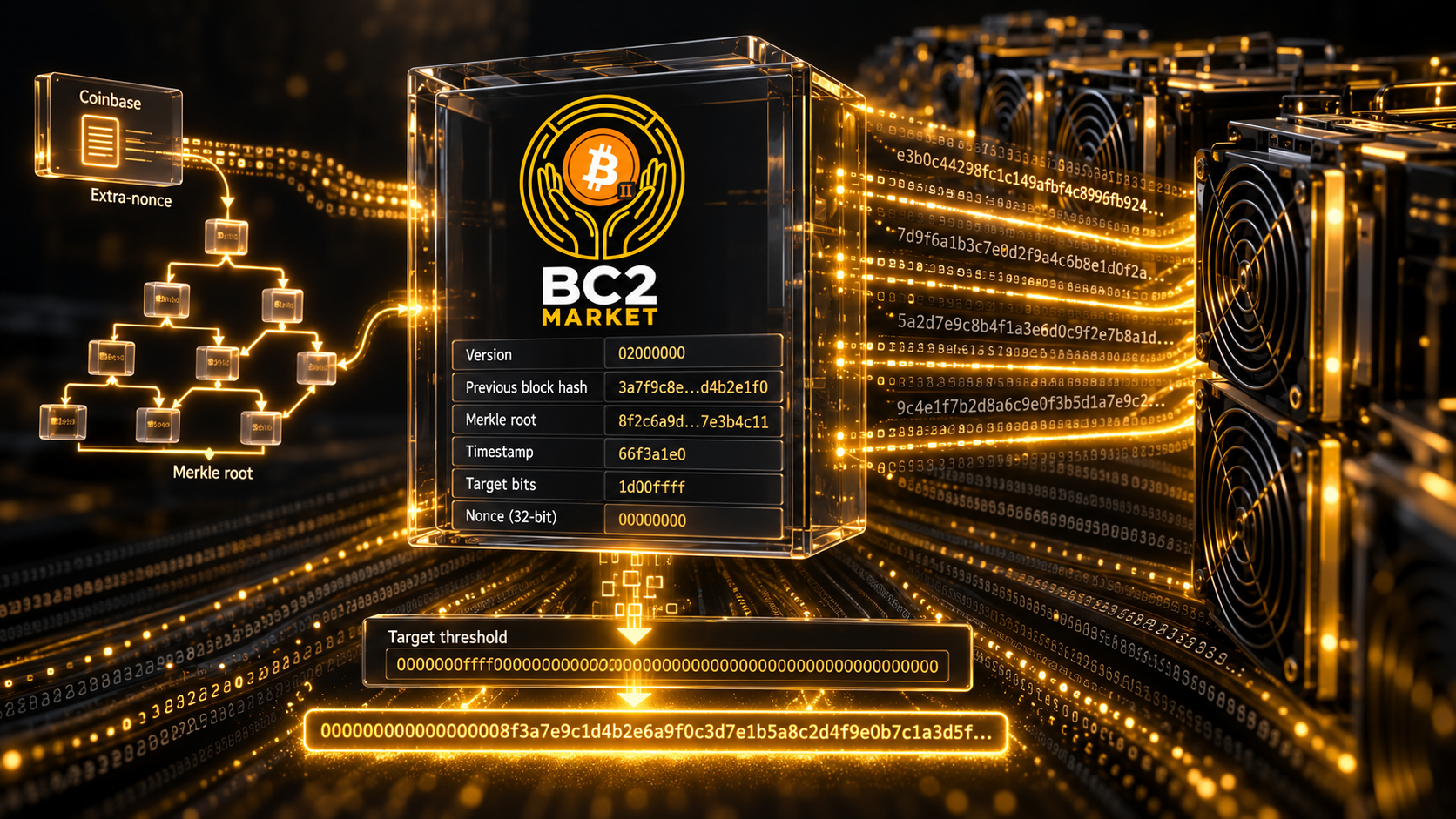
BitcoinII mining is the proof-of-work process that proposes new blocks, confirms valid native BC2 transactions and issues the block subsidy permitted by the consensus rules. A miner does not solve a conventional equation with one hidden answer. Mining hardware repeatedly hashes candidate block headers and searches for an output whose numerical value is at or below the target required by the Bitcoin II network.
The first miner to broadcast a valid candidate does not automatically control the result. BitcoinII Core nodes independently check the proof of work, block structure and every transaction. Nodes accept and extend the block only if it follows the current consensus rules. The accepted coinbase transaction can contain the allowed BC2 subsidy and eligible transaction fees; its output remains subject to coinbase maturity before it can be spent.
From transactions to a candidate block
A miner normally starts with valid transactions available to its node. It constructs a special first transaction called the coinbase transaction, selects other transactions and builds a Merkle tree from their transaction identifiers. The Merkle root commits the block header to that transaction set. If the coinbase data or any selected transaction changes, the Merkle root changes too.
The Bitcoin-derived block header is 80 bytes and contains six principal fields: version, the previous block hash, the Merkle root, timestamp, nBits and nonce. The nBits field is a compact encoding of the proof-of-work target. The nonce is a 32-bit unsigned field that mining hardware can vary. BitcoinII Core serializes this header and hashes it through the network's SHA-256 proof-of-work path.
What is a SHA-256 hash?
SHA-256 produces a 256-bit value. Explorers conventionally display that value as 64 hexadecimal characters. Hexadecimal is base 16: each character has 16 possible values, represented by 0 through 9 and a through f. A decimal digit has ten possibilities, not one hundred.
A 64-character hexadecimal value has 16^64 possible combinations, which is the same as 2^256—approximately 1.158 × 10^77 possible values. That enormous range does not make every individual hash special; SHA-256 maps each different input deterministically to one value in that range. Changing even a small part of the header produces a new output that miners cannot usefully predict in advance.
A real Bitcoin II block hash
At BitcoinII Mainnet height 62,616, the explorer reported this block hash:
0000000000000000fe7323e5d5343939085b4e7f04553ccc8010439d71f4817f
The leading zeros are part of its 64-character hexadecimal display. They make the value look small, but proof-of-work validation does not simply count zeros. A node interprets the hash as a 256-bit number and checks whether it is less than or equal to the target encoded by nBits for that block. A hash with many leading zeros can be a convenient visual clue, while the full numerical comparison is what matters.
Target and difficulty
The target is the maximum acceptable numerical hash value for the next block. A smaller target makes valid outputs rarer and therefore requires more expected hashing work. Difficulty is a human-readable way to compare the current target with a reference target. Bitcoin II targets an average block interval of approximately ten minutes, but individual blocks can arrive much sooner or later.
Current BitcoinII Core releases use the ShockWave per-block difficulty system. It adjusts required work from recent chain conditions rather than relying on the older 2,016-block retarget schedule described in historical material. Mining software must use the target supplied by a current compatible node and must not calculate eligibility from an old guide.
The 32-bit nonce
The nonce field ranges from 0 through 4,294,967,295. A miner can test nonce values in sequence, divide ranges among devices or use another search strategy; the consensus rules do not require starting at zero and adding one. Modern SHA-256 ASICs can exhaust a 32-bit nonce range quickly, so a miner needs ways to create fresh candidate headers.
Extra nonce and the Merkle root
The extra nonce is not another field in the 80-byte header. Mining software places extra data in the coinbase transaction. Changing that data changes the coinbase transaction ID, which changes the Merkle root and therefore changes the header. The miner now has a new set of nonce possibilities to search.
Mining software may also update the timestamp, choose a different transaction set or alter other permitted coinbase data. Mining pools commonly assign workers different extra-nonce space so their devices do not duplicate the same work. Together, these variations provide an effectively vast search space even though the header nonce itself is only 32 bits.
What hashrate means
Hashrate measures how many candidate hashes mining hardware evaluates per second. More hashrate increases a miner's share of the total attempts, but it does not guarantee when that miner will find a valid block. Each candidate is a probabilistic trial. Network difficulty, total hashrate, power cost, equipment efficiency, pool rules, fees and the BC2 market price all affect mining economics.
When a valid hash is found
The miner assembles and broadcasts the full block. Other nodes recompute the header hash, compare it with the target, verify the previous-block link and validate the transactions. A valid block becomes part of the accepted chain when nodes extend the branch with the greatest accumulated proof of work under the chain-selection rules. A candidate that fails any consensus check is rejected even if its hash meets the target.
Practical verification
Use a current BitcoinII Core node or the Bitcoin II explorer to inspect a real block's height, hash, nBits, nonce, Merkle root and transactions. Treat hexadecimal strings shown in diagrams as illustrations unless they are linked to a verifiable block. BC2 and BTC are separate networks, so do not use a Bitcoin block hash as proof of Bitcoin II activity.
Official references
Bitcoin II network overview: https://bitcoin-ii.org/about/
BitcoinII Core source: https://github.com/Bitcoin-II/BitcoinII-Core
BitcoinII Core block hashing implementation: https://github.com/Bitcoin-II/BitcoinII-Core/blob/v31.1.0/src/primitives/block.cpp
BitcoinII Core proof-of-work implementation: https://github.com/Bitcoin-II/BitcoinII-Core/blob/v31.1.0/src/pow.cpp
Bitcoin II explorer: https://explorer.bitcoin-ii.org/
This article is educational material. Protocol behavior can change in later software releases, so verify current BitcoinII Core documentation and source code when precise consensus behavior matters.