 BC2 MARKET
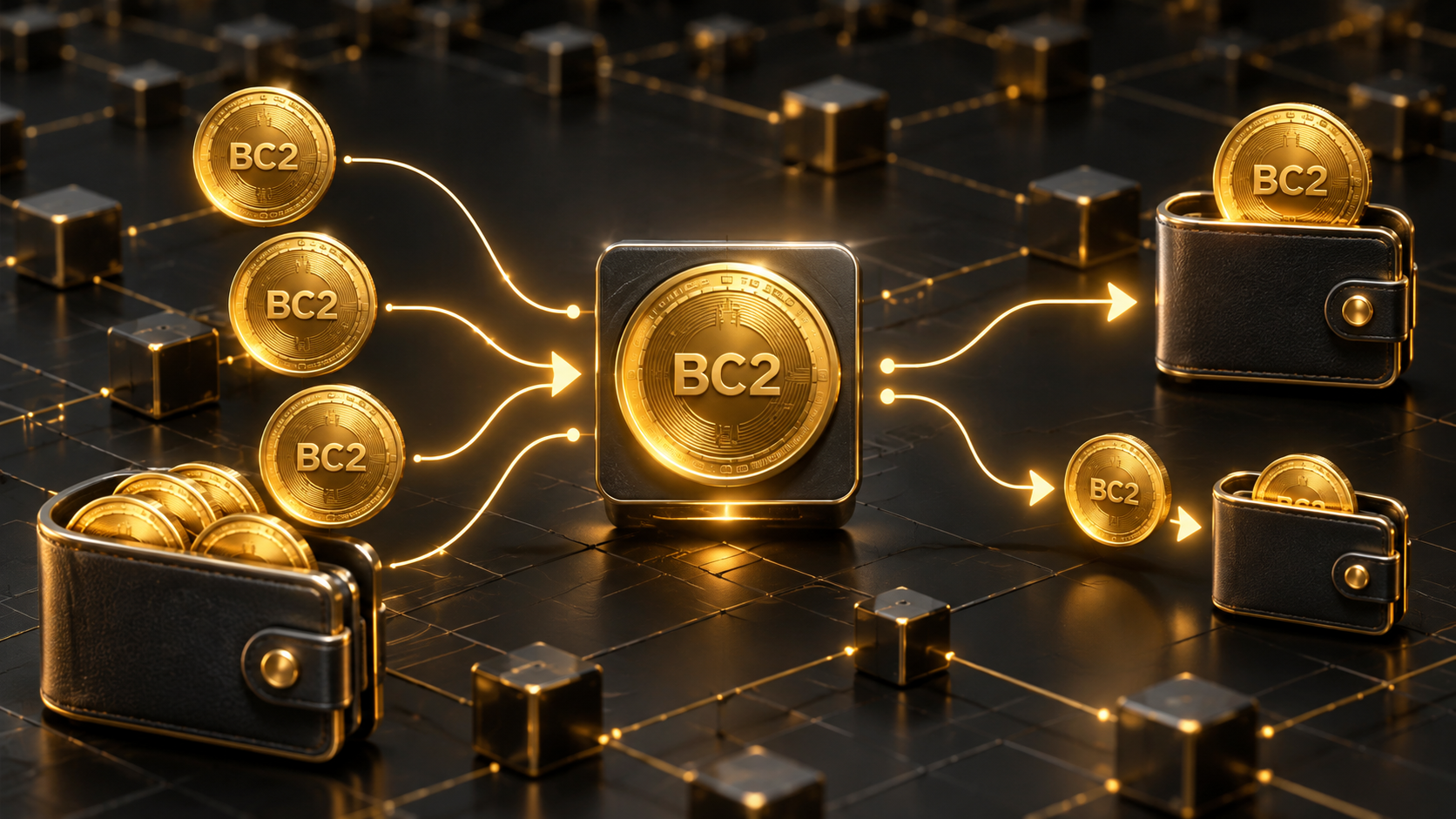
BitcoinII Core is full-node software for the Bitcoin II network and includes a wallet. The node independently validates blocks and transactions, while the wallet manages keys and tracks the transaction outputs those keys can spend. Unlike a bank account with one editable balance, native BC2 uses the unspent transaction output model, usually shortened to UTXO.
The cash analogy
Imagine that your physical wallet contains one $20 bill, one $10 bill and two $5 bills. Together they are worth $40, but they remain separate pieces of cash. If you buy something for $7 with the $10 bill, the whole bill leaves your wallet and you receive $3 in change.
A UTXO behaves like a digital bill. It is a specific amount created by an earlier Bitcoin II transaction. Your wallet balance is the sum of the spendable UTXOs controlled by its keys. A transaction cannot shave part of an existing output. It consumes the selected output in full and creates one or more new outputs.
Bitcoin-derived networks normally express their smallest native unit as one hundred-millionth of a coin. In BitcoinII Core, verify the amount and unit shown by your current software before signing a payment. The wallet interface normally presents values in BC2 while the protocol represents exact integer amounts internally.
Receiving BC2 creates a new output
Suppose someone sends 0.5 BC2 to an address controlled by your wallet. Once that transaction is recognized, its relevant output appears as a UTXO. Over time your wallet may collect many outputs from payments, mining rewards and change returned by earlier transactions.
Those outputs can have different confirmation counts and spending conditions. A newly mined coinbase output also has a maturity requirement before it becomes spendable. The wallet distinguishes total, unconfirmed, immature and spendable amounts rather than treating every visible coin as immediately available.
Sending BC2 consumes inputs
Assume your wallet has UTXOs of 0.10 BC2, 0.25 BC2 and 0.40 BC2, and you want to send 0.30 BC2. BitcoinII Core selects enough eligible inputs to cover the recipient amount and the network fee. If it selects the 0.40 BC2 output, that entire output is consumed.
The new transaction might create 0.30 BC2 for the recipient and approximately 0.099 BC2 as change back to a fresh address controlled by your wallet. The remaining difference, 0.001 BC2 in this simplified example, is the transaction fee. The exact fee and change depend on the transaction's serialized size, the selected inputs, output scripts and current fee policy.
After confirmation, the old 0.40 BC2 UTXO no longer exists as a spendable output. Your wallet instead tracks the new change output together with the untouched 0.10 BC2 and 0.25 BC2 outputs. Your displayed balance falls by the sent amount plus the fee even though the pieces making up that balance have changed.
Why the UTXO model matters
Every input points to a specific earlier transaction ID and output index. Full nodes verify that the referenced output exists, satisfies its spending conditions and has not already been spent. This makes ownership transitions explicit and allows independent nodes to detect an attempted double spend.
Transaction fees are driven mainly by data size, not simply by the amount of BC2 being sent. Spending several small UTXOs normally needs more input data than spending one larger UTXO with the same total value. A wallet full of tiny outputs can therefore produce a larger transaction and a higher fee at the same fee rate.
How BitcoinII Core selects coins
For an ordinary payment, the wallet automatically chooses eligible UTXOs, estimates the fee and decides whether to create change. Selection behavior can vary with the BitcoinII Core version, wallet type, fee settings and available outputs. It is safer to describe its objective than to assume that every release uses exactly the same Bitcoin Core algorithm: it must fund the payment and fee while avoiding wasteful or uneconomical results.
If the current BitcoinII Core GUI exposes Coin Control, advanced users can select specific inputs from the Send screen after enabling the feature in the wallet options. Coin Control can help keep unrelated funds separate, avoid spending a particular output or consolidate small outputs when fees are acceptable. It can also reduce privacy when used carelessly because combining inputs reveals that one transaction could authorize all of them.
Inspecting UTXOs with RPC
BitcoinII Core builds use the Bitcoin II command-line client supplied with the release. Its executable name and path can differ by operating system and package, so use the client included with your installation rather than copying a Bitcoin-only command blindly. In a configured Bitcoin II data directory, these wallet RPC methods are useful:
listunspent — lists wallet UTXOs and fields such as transaction ID, output index, address or script information, amount, confirmations and spendability.
getbalances — reports wallet balance categories supported by the current release.
getwalletinfo — reports the loaded wallet's state and capabilities.
listtransactions — shows recent wallet transaction history; it is not a replacement for the UTXO list.
RPC access is sensitive. Run commands locally or through a properly protected administrative channel. Never publish RPC credentials, expose an authenticated RPC port to the internet or paste wallet secrets into a website. Read-only inspection should use a wallet and node configuration appropriate for the task.
Confirmations, locks and unavailable outputs
A UTXO shown by the wallet may still be unavailable because it is unconfirmed, immature, manually locked, already reserved by another pending transaction or subject to a script condition. Watch-only wallets can display outputs without having the private keys required to spend them. The wallet's spendable balance is therefore more useful for a new payment than a raw sum of every output it knows about.
Practical guidance
Let BitcoinII Core perform automatic input selection unless you understand why a specific coin must be chosen. Review the destination, amount, fee and resulting change before signing. Keep a tested wallet backup and protect the passphrase separately. When troubleshooting a balance, compare the wallet's UTXOs, confirmation state and transaction IDs rather than assuming the visible total is one indivisible account balance.
Official references
Bitcoin II website: https://bitcoin-ii.org/
BitcoinII Core downloads: https://bitcoin-ii.org/download/
BitcoinII Core source: https://github.com/Bitcoin-II/BitcoinII-Core
Bitcoin II explorer: https://explorer.bitcoin-ii.org/
This article is educational material. Wallet behavior and available RPC fields can change between releases, so verify commands against the BitcoinII Core version you are running before moving a significant amount.