 BC2 MARKET
BitcoinII (BC2) is an independent decentralized digital payment network with its own blockchain, peers, miners and native coin. It is not Bitcoin and it is not simply a token on another chain. Users can transfer BC2 directly over the peer-to-peer network, while BitcoinII Core nodes verify transactions and blocks according to the network's current consensus rules.
BC2 can have a market price, but price appreciation is not guaranteed. Treating any cryptocurrency as an investment involves volatility, liquidity, custody and technical risks. The network's primary technical role is to maintain a shared ledger for native BC2 transactions without requiring one central database operator.
A distributed ledger
The Bitcoin II blockchain is a sequence of validated blocks. Full nodes independently download and verify the chain. Archival nodes may retain the complete block data, while pruned nodes can discard older block files after validation and keep the information required to continue enforcing the chain. It is therefore more accurate to say that many independent nodes validate a common history than to claim that every node always stores an identical complete copy.
When a node receives a new block, it checks the block's proof of work, structure and transactions against the consensus rules. A block that fails validation is rejected. Nodes also compare valid competing branches and follow the chain with the greatest accumulated proof of work under the protocol's chain-selection rules.
What is inside a block?
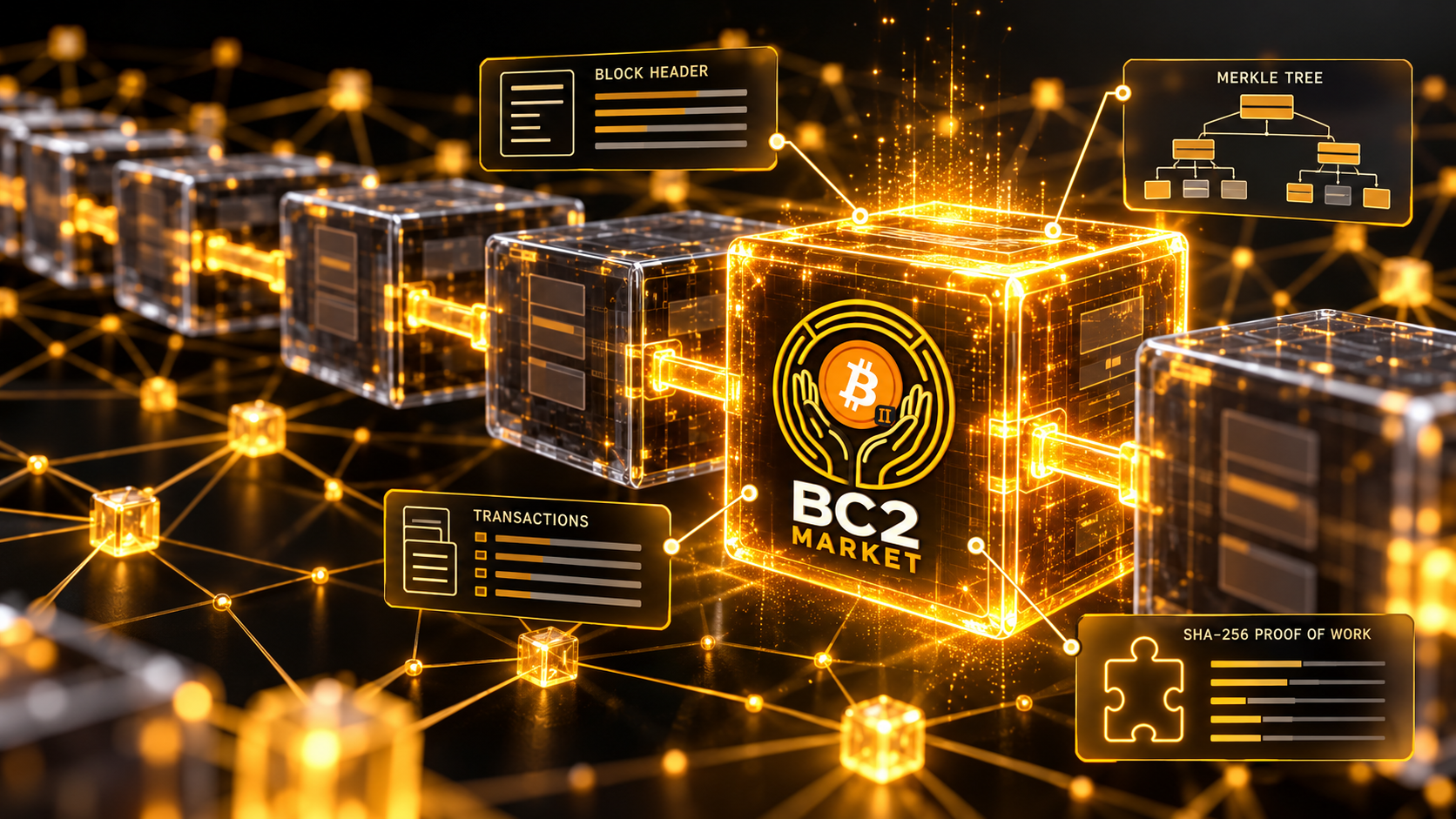
A Bitcoin-derived block contains an 80-byte header followed by its transactions. The header commits to the current block and links it to the preceding block. Its principal fields are:
Block version: a version field used to signal and interpret block-rule behavior. It is not the BitcoinII Core application version.
Previous block hash: the identifier of the preceding block header, linking the history together.
Merkle root: a commitment derived from the transactions included in the block.
Timestamp: the miner's block time, subject to consensus validation rules.
nBits: the compact representation of the proof-of-work target.
Nonce: a 32-bit field miners can vary while searching for a valid header hash.
The block height is not a separate field in the 80-byte header. In modern Bitcoin-derived chains, the height is committed within the first transaction—the coinbase transaction—under the applicable consensus rules. The coinbase transaction also creates the permitted block subsidy and collects transaction fees.
Why blocks are linked
Changing a confirmed transaction changes the transaction commitment and therefore the block header hash. Because the next block names the previous block hash, altering an older block would also break every later link. An attacker attempting to replace that history would need to produce a valid alternative chain with enough accumulated proof of work to overtake the accepted chain. This makes confirmed history increasingly expensive to rewrite, but it should not be described as mathematically impossible to change.
What mining does
Mining is the competitive proof-of-work process used to propose the next valid block. A miner selects transactions, constructs a coinbase transaction, calculates the Merkle root and assembles a candidate block header. Mining hardware repeatedly hashes variations of that header using SHA-256 until it finds a hash whose numerical value is at or below the network target.
The 32-bit nonce is one field that can be changed, but miners do not have to begin at one or increase it in one fixed sequence. They can also modify the coinbase transaction, extranonce data, timestamp or transaction selection, which changes the Merkle root and creates a new search space. ASIC devices are designed to calculate enormous numbers of SHA-256 hashes per second. That rate is their hashrate.
Finding a valid hash does not let a miner ignore the rules. The miner broadcasts the candidate block, and other nodes validate it before extending it. If the block is accepted, its coinbase output contains the allowed block subsidy plus collected transaction fees. The coinbase reward must mature for the required number of blocks before it can be spent.
Difficulty and block timing
Bitcoin II targets an average interval of approximately ten minutes between blocks. This is a statistical target, not a schedule: individual blocks can arrive sooner or much later. Current BitcoinII Core releases use the ShockWave per-block difficulty system, which adjusts required work based on recent block conditions while continuing to enforce proof of work.
What users need to know
A user does not need to operate mining hardware to send or receive BC2. A compatible wallet constructs and signs transactions, while a BitcoinII Core node can independently verify the network. Users should still understand that BC2 and BTC are separate networks, verify receiving addresses carefully, protect wallet keys and backups, and wait for an appropriate number of confirmations before treating a payment as final.
Official references
Bitcoin II website: https://bitcoin-ii.org/
Bitcoin II overview: https://bitcoin-ii.org/about/
BitcoinII Core downloads: https://bitcoin-ii.org/download/
BitcoinII Core source: https://github.com/Bitcoin-II/BitcoinII-Core
Bitcoin II explorer: https://explorer.bitcoin-ii.org/
This article is educational material, not financial advice. Protocol details can change with new software releases; verify current project documentation and source code when precise consensus behavior matters.